Podcast audio introduction:
https://www.podbean.com/media/share/pb-5pkdp-13855d7
This book is rated PG 13 for audiences of that rating’s restriction, the movie is R Rated
By Andrea Menzies 02/07/23
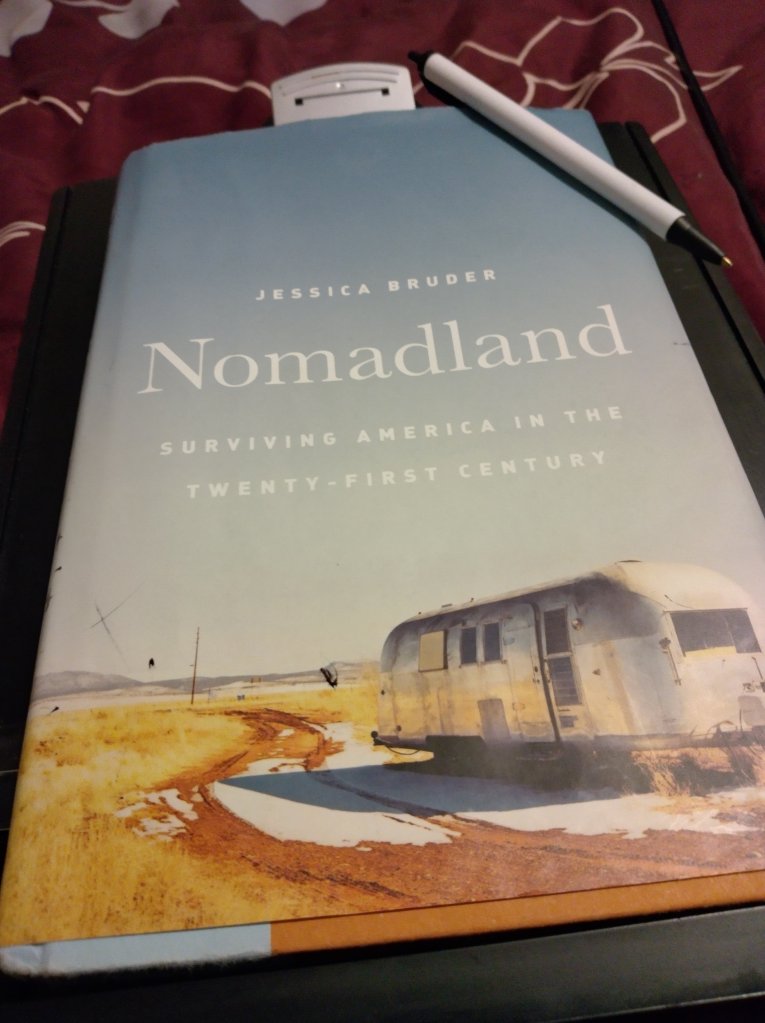
This week FH7 Book Reviews has a review on the book Nomadland published in 2017. It was then made into a successful high-earning art film movie in the year 2020 called Nomadland. It got 7.4 out of 10 stars on IMDB movies dot com and won 3 Oscars with 136 nominations. Saturday Night Live even mentioned it in a skit a while back with one of the actors on SNL dressed up as the actress of the movie talking about the movie. When the FH7 Book Club first created the podcast our first mission statement was to talk about books made into movies. As this was BOTH a best selling book AND movie it seemed right on target with the podcast theme. Some parts of the Harry Potter books for example DO NOT make it to the movie. For example Ms. Granger starts a house elf labor-union.
There is therefore LOTS of material to discuss in movies being based on books, and this book is NO exception. There are in fact VERY FEW parts of the Nomadland book that make it into the movie at ALL as the movie director Chloe Zhao pretty much COMPLETELY diverges from the book entirely so much so it is hard to tell they are somewhat the same story. A few moments in the book do make it to the movie by the end yet in summary I liked the book and hated what the book did to it. The IMDB webpage does say “Based on the book by Jessica Bruder” yet I was unpleasantly amazed at the liberties taken with the stories. For example the book is told from the perspective of Jessica Bruder a journalist who decides to live in an RV van, and collect the stories of other people living in RV vans and other RVs full time. At one point in the book she mentions she is age 37 on page 187. She is not the elderly start portrayed in the show. She does have an apartment she lives in by herself to go home to as she has a travel-van on the side for vacation travel. There are travel-van RV vehicles made by corporate RV manufacturers and sold on RV dealer lots, and hers is one made by an RV dealership unlike the homemade movie one. The inside cover shows a young woman with NO gray hair that is brown, shoulder length and styled at a salon.
“Jessica Bruder is an award-winning journalist whose work focuses on subcultures and the dark corners of the economy… Bruder teaches at the Columbia University Graduate School of Journalism.” The inside cover says.
“Burning Book: A Visual History of Burning Man.” By Jessic Bruder is another one of her books. If you have EVER looked at the photos of Burning Man and music festivals like Burning Man many people take Recreational Vehicles called RVs for short or vans converted into RVs with little beds and kitchens to the events. This likely sparked her interest in the topic of nomadic people.
Meanwhile the movie description on IMDB says the movie plot is the following. “A woman in her sixties, after losing everything in the Great Recession of 2008, embarks on a journey through the American West, living as a van-dwelling modern nomad.” The movie then shows an older woman with gray hair, short cropped into a man’s hairstyle, hair she cuts herself, having a few possessions and no permanent home address in a home-made van. I read the book along with a lady named Anne in my book group, and she explained it this way: “The movie has a composite character that has many of the ladies the author interviews for the book stories made into ONE single fictional character. It would be too time consuming to tell dozens of separate people’s stories, so they sort of morph the main stories into one sad person’s travel journey.” However my theory was that the book has a side plot of protesting seasonal and retiree worker labor unionization and reform, and corporations who don’t want that to happen bought the book rights to kill the books popularity, humiliate the people interviewed, and try to kill off and discredit the story. A very valid interpretation if you look at the changes made, and it makes me wonder how often this kind of thing is done to stories of unionizing workers.
The book Nomadland has an attractive, wealthy, teacher in her 30s as a lead character. The Movie has an older and sicker lead character named Fern played by the actress Frances McDormand who was the lead in the movie “Fargo” as the lady-cop. Fern in the movie smokes, binge drinks, and parties constantly after her husband’s death. The real character in the book mentions many times she is a recovered alcoholic who never drinks and smokes. This change is obviously made to humiliate and discredit the woman the character is based on. Still McDormand is very famous, and is also in the movie The French Dispatch, Almost Famous, and the Tragedy of Macbeth. Yet fans of Gothic books and comic books who love author Neil Gaiman’s work will remember her for being the Narrator “God” voice in “Good Omens” the TV Series.
A passing guest star is the YouTube sensation Bob Wells. He is famous in real life for living in travel trailers, trucks, and vans for many years. He hosts groups of caravans that meet up in Quartzite, AZ yearly to cross the boarder to get medical care in Mexico. One of the issues this book discusses is lack of medical care in the United States, and just how many people are still crossing the boarder for cheap medications. This fact is pointing out that a passive star of the book and film are travel nomad life itself. In the pandemic RV sales tripled all over America as hotels closed, and hotel prices have surged as the Internet has made price fixing at high rates all over the internet easier for hotels. Housing prices have skyrocketed as financing has become harder to get, and wages have not increased along with prices. In addition journalist planted secret cameras everywhere and found many “clean” hotels had unmasked cleaners coughing everywhere. Which begs the question how clean have these places EVER been? At least with an RV you know where it has been.
What is very interesting to me is I read the book in 2021. The book was being written in 2017, right BEFORE the pandemic. However, many interviews suggest the van people KNEW of the impending pandemic. The TV show Walking Dead’s first season has a character named Dale. He has an RV, and the main characters which survive are all in and RV convoy. Disaster “Prepper” people have long advocated having a bug-out truck with camper or camper-van well stocked. This is called living off-grid and being a van life fan has a high cross over rate with fans of off-grid living. “The Grid” is another word for the city electric grid, and many people feel the dependence on city electric grids is dangerous and polluting. Over 70% of city electric energy still comes from fossil fuel burning energy plants around the nation. The book mentions this at many points.
The book then interviews many types of RV and van fans. Many other travel van fans are costume-role players on their way to Comic-Con trips. They have taken up the RV van hobby as a way to penny pinch on Comic Book Convention hotel fees. Over-seas TV has many camper-van fans in Japan, and the BBC’s Top Geer show. 80s style punk rockers admire Henry Rollin’s first music biography book called “Get In The Van” as he lived inside a van before getting famous. 80s vintage fans loved that Mr. T lived in a van, and so did the Scooby gang. The absolute inventors of van culture are the 1960s and 1970s surfer-culture VW van fans. Crashing next to the beach is a popular use of travel vans. This book interviews many of each.
Living tiny has many roots before modern wheels. In Europe many peasant huts outside of castles were only 120 feet in length. Huge forts and castles were often ONLY used for war in many regions. Tee-pees were on average only 95 square feet on the inside in the Winnebago Tribe of Nebraska. Gypsy and Tinker-styled travel wagons were also around 95 feet commonly. Pioneers often lived in covered wagons or log cabins with small indoor space. Henry David Thoreau in the year 1854 wrote the famous book Walden Pond to protest the material excesses in large-house living emerging even in his day. Tiny house living has in this way always been connected to Civil Disobedience and Social Protest. It is a strange construct of modern day that we must all have a 4 car garage, 8 bedrooms, and a pool to live a “normal” life. One thing corporate America hates about van-life, is that these are some of the few people who can afford to PROTEST corporate America well. People with large houses afraid of losing high paying jobs are scared to protest too loudly on social issues, and this is NOT by mistake. Many corporations want people terrified of upsetting their bosses so social change never happens. Nothing shows this more clearly than the pandemic. People were suddenly protesting statues and other social issues. Did they just suddenly become angry? No. They suddenly had no job to fear losing so they gained a protest voice. “The things you own… Own you.” Is a phrase I heard in the movie “Fight Club” as a kid and did not understand it, but as a grown up I know all too well. Nomadland the book mentions this idea many times.
The book then attacks “Seasonal Work” for retirees. I did temp work for Amazon once, and really hated it. They had me operating huge machines with a few seconds of inaccurate training. Supervisors disappeared with no instructions. I was covered with 6 bruises of 4 inches each before the temp work ended. I am barely over 35, and I wondered how the heck they expect retired elderly people to do any of this work. The author Bruder does temp work for Amazon, and has the same response. How do they expect average older people to do this it is vicious and injury inducing! Then she works many seasonal jobs around the nation covered in bruises. She is a University professor in real life, and did not need to do any of this work. She found many instances of unsafe work environments and abuse never being stopped even when lawsuits were filed and “authorities” were called. She often saw pay-offs and bribes handed to the so called authorities.
“Now I see why they had the characters pounding shots, and acting wild in the movie. It said in the books they never touch the stuff.” I said to myself. It is called discrediting the witness, and the makers of the movie were trying to make the social protestors who voiced an alarm look bad. It happens all too often in the United States. I hope more people read the book Nomadland, and don’t think they “know” the story from the movie.
I like the book, give it a good review, and give it five stars. It is a story of survival and friendship, and learning to live with hard situations. I recommend reading the book first, and then seeing the movie. Like so much information you have to be the real judge of truth.


Leave a comment